Micro-Compacts vs Subcompacts
Conceal Carry Evolution
The last decade has brought an explosion of ever-shrinking concealed carry guns, primarily divided into two categories: micro-compacts and subcompacts. Shooters no longer have to choose between size, capacity, and ballistic effectiveness.
For concealed carriers, these advances are a game-changer. Instead of dressing around the gun, carriers can now pick a trusted firearm, pair it with a good holster, and head out the door. This “set-and-forget” approach to concealed carry was unheard of in the past unless someone carried a pocket revolver.
Both micro-compact and subcompact pistols are excellent choices, but they aren’t the same. Factors like physique, climate, and personal preferences will help determine which works best.
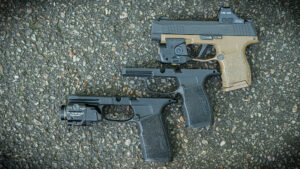
Compact vs Subcompact vs Microcompact
Although these labels sound confusing, they’re fairly straightforward once you get accustomed to the gun nomenclature they’re derived from. What modern shooters call a full-sized handgun, e.g., a model 17, a Beretta 92FS, or a 1911, was simply referred to as a handgun in the past. When companies began reducing the size of these handguns for civilians and detectives, the compact term popped up.
But even before this, companies like Colt had introduced handguns marketed as pocket pistols, which made them compact handguns. Guns like the 1903 hammerless and the earlier FN 1900 were excellent handguns to put in the heavy overcoats of the day. Now, they’re a little too large, lack capacity, and are chambered in .32 ACP, which most shooters would never recommend for concealed carry. But the term compact didn’t really enter the lexicon of shooters until Smith and Wesson introduced their Model 39 back in the 1950s.
This little handgun was the smallest 9x19mm handgun available at the time, and was the first double/single-action handgun to gain commercial success in the United States. And it wasn’t limited to just civilians and police; the gun would later be modified by the Naval Special Warfare units in Vietnam to accommodate a stagger-column 14-round magazine. And this is, in my opinion, the first real modern compact handgun as it meets the following criteria: smaller than a military-issued handgun, chambered in 9mm or more powerful cartridge, feeds from a double-stack magazine, and can be concealed easily.
If you’re thinking you haven’t seen many Model 39s around, you’re probably mistaken. I say this because the Model 39 continued to evolve into dozens of different Smith and Wesson auto-loading handguns in various calibers and sizes, and until the mass adoption of the Glock, was the go-to Wonder Nine for police and government agencies across the country. And while these guns are considered by many to be outdated compared to modern polymer-framed automatics, they can still hold their own and virtually last forever. My late 1990s Model 5906 has served me well for several years and thousands of rounds. What makes this more impressive is that before I owned it, the gun was a Puerto Rican Police Department gun and saw plenty of use and abuse in a high-humidity environment, and it still looks new.
But back to the topic at hand, the most common compact handgun on the market today is the Glock model 19, which is itself a reduced-size Model 17 (the original Glock semi-automatic handgun). Since the early 2000s, every professional instructor recommended this gun to anyone looking to carry something other than a pocket pistol. And for good reason: the Glock 19 is one of the most reliable handguns in the world, and back in 1988, when it was introduced, it was peerless for reliability and weight. But it’s no longer 1988, and there are dozens of designs on par with the Glock, with many of them substantially smaller and lighter despite having the same capacity. And these new handguns became the subcompacts and micro compacts we see today.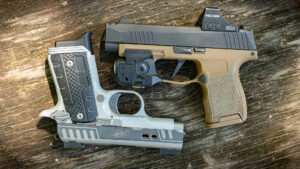
Subcompact Handguns
Sub-compact handguns are handguns that are even smaller than compact handguns, but aren’t so small that they can be pocket-carried. Sure, some of them can be shoehorned into that role, but in general, shooters will want to use an IWB holster to effectively carry these pistols.
Some great subcompact examples are the Glock 26, the Canik METE MC9, the older SIG P239 (although this one is single-stack), and ironically, the Springfield Armory XD Sub-Compact. All of these guns are effectively cut-down versions of existing compact designs, with the only exception being the SIG, which is just a slimmed-down P229. As such, all of them are fairly easy to shoot. Not as comfortable or low-recoil as, say, a compact handgun like the Glock 19, SIG P229, or the Beretta Centurion, but still, with practice, or available magazine baseplate extensions, they’re only slightly more difficult to shoot than a full-sized handgun.
Examples:
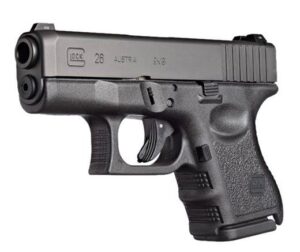
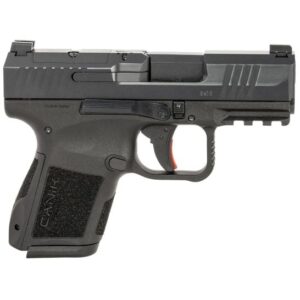
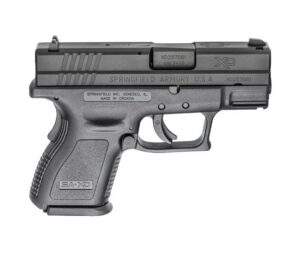
They’re generally much easier to conceal than standard compact handguns, and many of them can actually use a full-sized magazine as a spare that will protrude past the grip (The SIG P239 being a notable exception). For many shooters, these guns strike the perfect balance among capacity, shootability, and concealability for everyday carry. But they do have some drawbacks.
For starters, unless you’re trying to bring MC Hammer’s parachute pants back in style, you can’t reasonably carry one of these guns in a pocket. (And truthfully, you shouldn’t, since none of them feature a manual safety.)Also, they’re a little too thick to carry with form-fitting clothing. Not so bad that you’ll have to wear the old fisherman’s vest found at every IDPA match, but a loose jacket over a shirt is a great way to dress around the gun without feeling like you’re doing so.
Pros:
- Balance between capacity, concealability, and shootability.
- Reliable for everyday carry.
Cons:
- Too bulky for true pocket carry.
- Clothing fit may limit concealment without adjustments.
Micro Compact Handguns
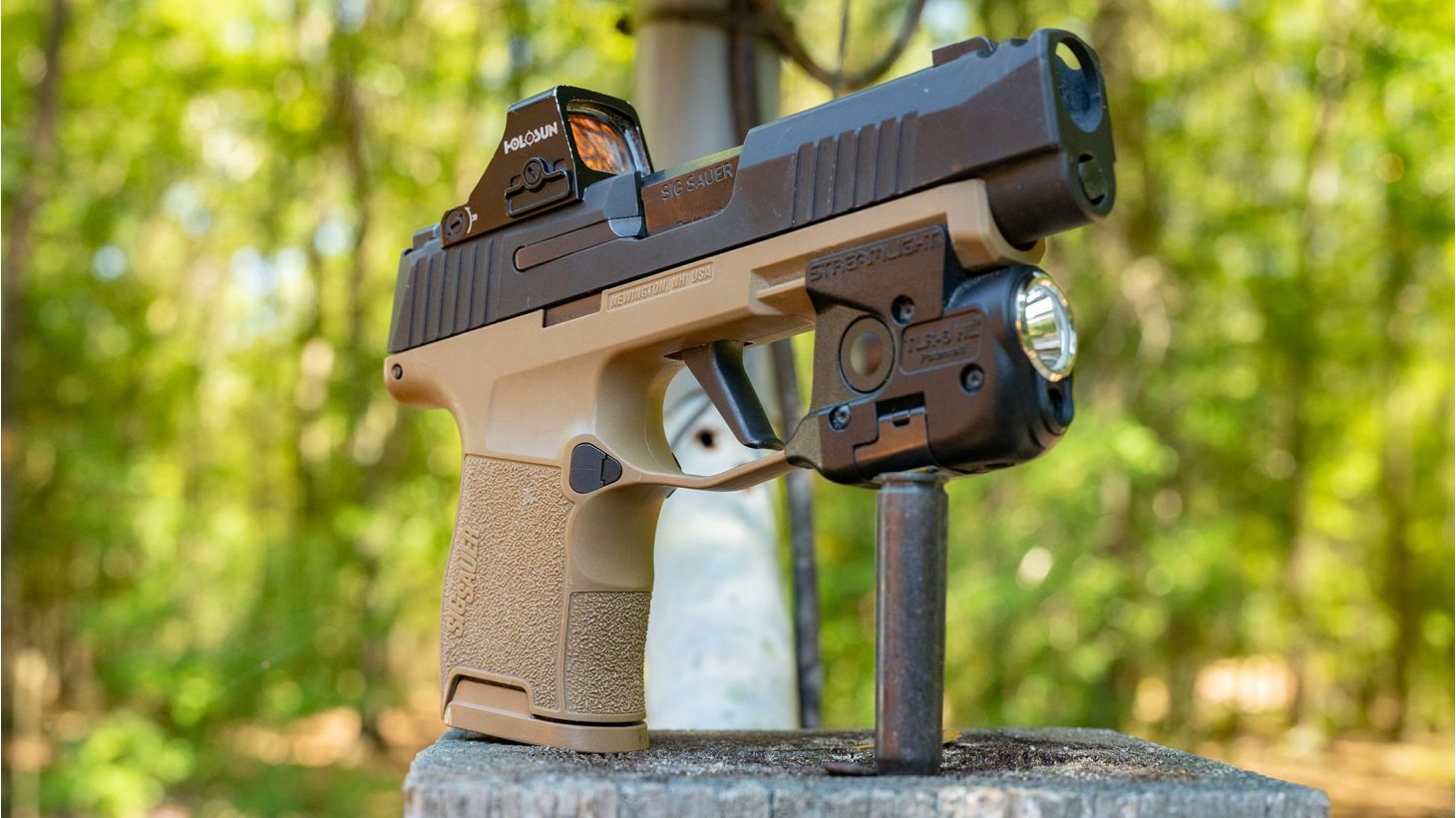
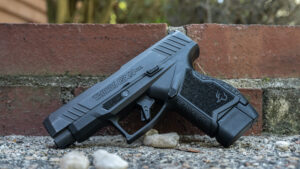
But what about shooters who want something ultra-small that doesn’t sacrifice on capacity or terminal ballistics? Until a few short years ago, this meant something like a Seacamp or a snub-nosed .357 Magnum revolver. That is, until Glock unveiled its G43 micro-compact pistol.
With it came the rise of ever-shrinking polymer-framed, semi-automatic, magazine-fed handguns designed for deep concealment. With some of these handguns able to match or exceed the capacity of the go-to gold standard for concealment, the Glock 19.
Namely, the SIG P365 – my current go-to carry gun. Given that I don’t carry the pistol in the true micro-compact configuration, but rather a long-slide, short grip setup that gives me the increased accuracy and terminal ballistics while still staying concealable.
But it wasn’t just SIG that answered the call for smaller, full-power micro compact pistols; guns like the Springfield Hellcat have done extremely well with concealed carriers. Even Ruger, who normally waits to jump on trends, delivered with their excellent MAX 9 pistol. So while the early 2000s were the golden age of surplus guns, a strong argument can be made that the 2020s are the golden age of concealed carry handguns.
For younger shooters, it’s hard to understand, but it wasn’t that long ago that a shooter looking for something they could conceal with summer or active wear clothing had to settle for either an anemic caliber automatic like the Beretta Tomcat chambered in .32 ACP, a revolver in 357 Magnum, or if they wanted something extremely concealable, a derringer like those from Bond Arms.
Now, I can wear khaki shorts with a 9mm SIG P365 that effortlessly conceals and carries 10 rounds of 9mm with a spare 15 or even 21-round magazine in a pocket. That is a tremendous amount of capacity to bring to bear on a carjacker or mugger looking to do you harm
Pros:
- Extremely easy to conceal, even with summer or active wear.Offer higher capacities than pocket revolvers or older autos.Extended magazines provide flexibility for capacity.
Cons:
- Increased felt recoil, louder shots, and more muzzle flash.
- More difficult for some shooters to handle under stress.
Choosing the Right Pistol
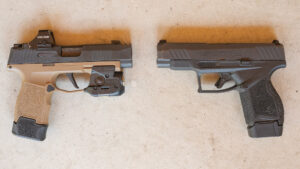
It really depends on your body type, environment, and fashion sense – assuming you don’t want ot have to dress around the gun. For shooters living in tropical locations or out west in places like Nevada or Arizona, micro compact pistols are going to be ideal since they are by far easier to conceal. If a shooter is concerned about limited capacity, most of these guns offer a larger, extended magazine that a shooter can slip into a pocket and have plenty of ammo for any situation. The only downside is that these guns are so small that they can be difficult to shoot due to increased felt and perceived recoil (shorter barrel means louder shot, and bigger muzzle flash, which can cause some shooters to flinch).
For shooters where summer temperatures rarely exceed 80, a subcompact will be a great choice. Just like the micro, they’re easy to conceal, function well with defensive ammo, and are fast to draw and reload. They also have the added advantage of being a little easier to shoot, which should translate into better odds of success.
Regardless of choice:
- Try different models at a rental range.
- Practice regularly with both live and dry fire.
- Prove reliability with at least 100 malfunction-free rounds of your chosen defensive ammo before carrying.
- When it comes to concealed carry, both subcompacts and micro-compacts are excellent, but the best choice depends on your lifestyle and comfort level.