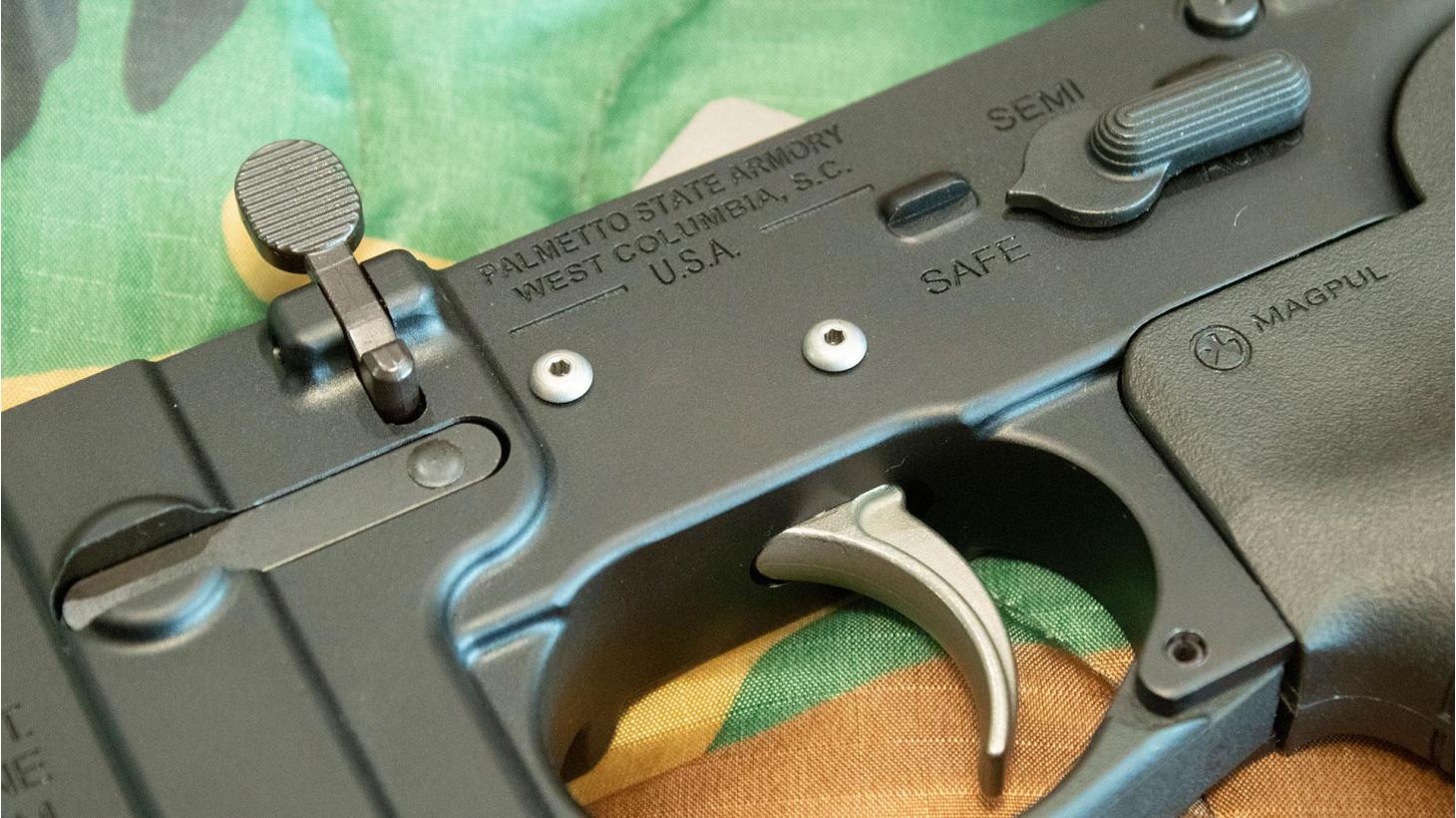
Hey, y’all welcome to another quick tip by gunandpartspros today. We’re talking trigger pins. So let’s jump right. These PSA custom anti-walk pins are a great addition to any build. They mitigate movement during the course of fire, which increases the trigger’s accuracy, and reliability while also protecting the receiver’s trigger holes from becoming elongated. Inside, you will get two hex keys, the installation accessory, two anti-walk pins, and their adjoining screws. These are available in both stainless and nitrided finishes. Parts and Tools List: Anti walk pins Two Hex Keys Installation accessory Two anti-walk pins Adjoining screws Hammer Bench Block Punch Lower Receiver The tools you’ll need for this are a hammer, a bench block, and possibly a punch if your original pins are being stubborn. Today, if needed, I’ll be using a ⅛” punch. Now that we got the parts and tools out of the way, let’s jump into this installation. Step 1: Hammer Pin Removal and Replacement [01:07] Now, before we start, we want to make sure that the hammer is in the fire position. Then we’ll grab one of our anti-walk pins and the installation accessory. We’ll screw the tip of the installation accessory onto the anti-walk pin and we’ll use this pointed tip to knock out our hammer pin. To do so we’ll grab our hammer, place the pin over it and just knock it into place. Now, depending on your bench block, you may need to remove the old pin to get it seated all the way. Once it’s all the way through. We can remove the accessory and we can move on to the trigger pin. Step 2: Trigger Pin Removal and Replacement [01:58] Following the same steps. We’ll install the accessory tip onto the anti-walk pin, lining it up with the trigger pin. We’ll knock it into place. Make sure it’s seated. We’ll remove the tip. And now we can put on the screws to make sure that these are lined up correctly. Step 3: Securing the Anti-Walk Pins [02:26] Now for this next part, you’re going to want to make sure that you have both the pin screws and your two hex keys. To start we’re just going to grab one of the screws and choosing either pin, we’ll go ahead and get the thread started. We’re not going to worry about tightening it down yet. We just want to get it in there and make sure it’s held in place. We’ll do the same for the hammer pin now. Just getting started and now both are held in place. We’re just going to pull it up, grabbing our first hex key, making sure it’s seated on the correct side. Get the adjoining screw. We’re just going to tighten it down. Give it a little torque and she’s good to go. Move on to the hammer pin. Both are seated. Give it a little twist and she’s in place. Step 4: Functions Check [03:38] Now we’re ready to check the function. With it on safe, we’ll pull the trigger. It does not fire. Put it on fire. Pull the trigger, the hammer falls while holding the trigger, push down on the hammer. Make sure it resets. It does, fire it again and we’ll put it back on safe. Now your lower is ready to go back onto the upper and you’re ready to hit the range. Hey guys, thanks for watching. Be sure to hit us up in the comment section down below. If you have any questions and check out the description for the complete parts and tools list and everything you saw in the video today, we’ll catch you next time. Seasonal Sale: Up to 15% Shop Now
Subcompact vs Micro-Compact Handguns: Everything You Need to Know Before Carrying
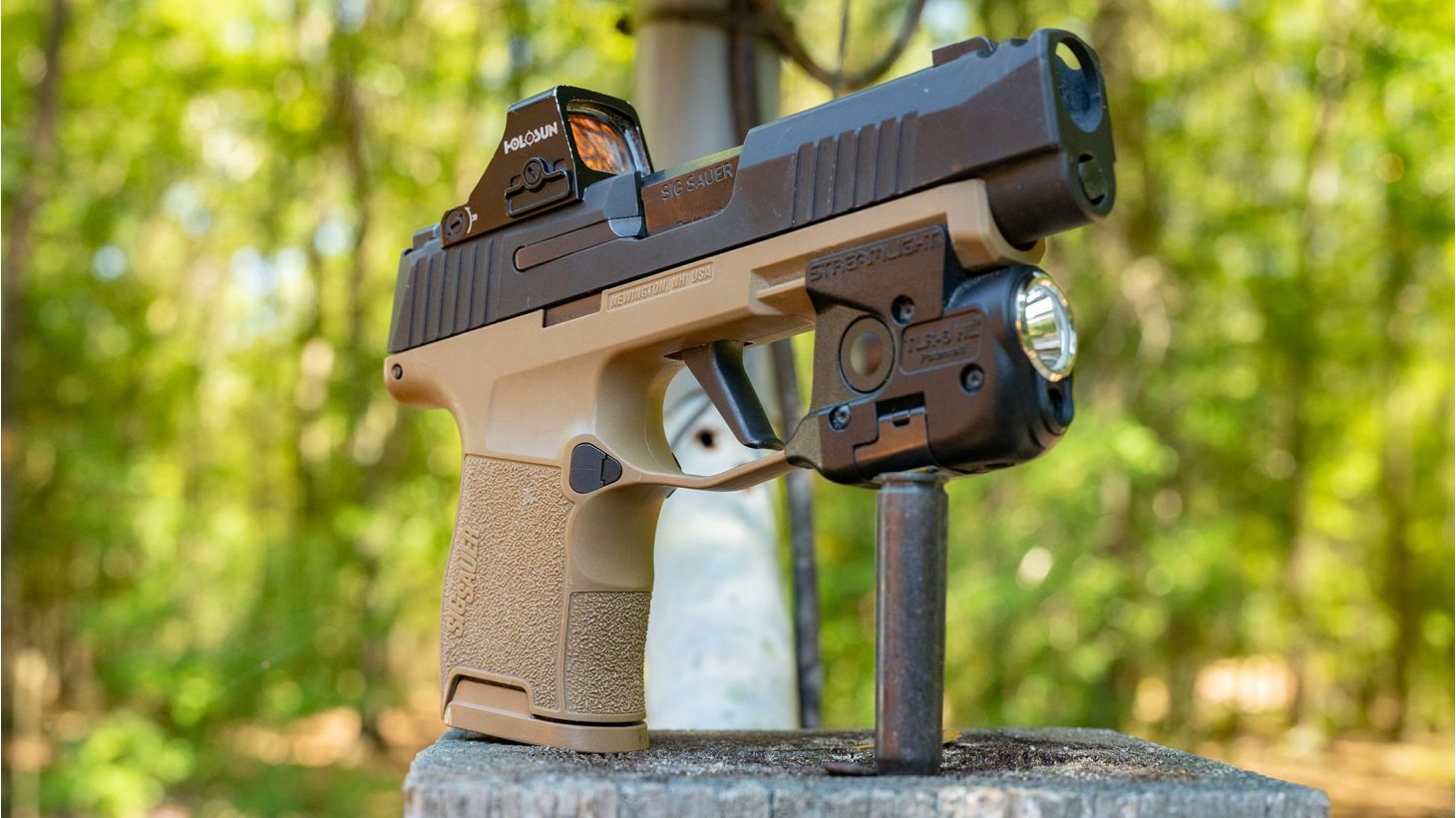
Micro-Compacts vs Subcompacts Conceal Carry Evolution The last decade has brought an explosion of ever-shrinking concealed carry guns, primarily divided into two categories: micro-compacts and subcompacts. Shooters no longer have to choose between size, capacity, and ballistic effectiveness. For concealed carriers, these advances are a game-changer. Instead of dressing around the gun, carriers can now pick a trusted firearm, pair it with a good holster, and head out the door. This “set-and-forget” approach to concealed carry was unheard of in the past unless someone carried a pocket revolver. Both micro-compact and subcompact pistols are excellent choices, but they aren’t the same. Factors like physique, climate, and personal preferences will help determine which works best. Compact vs Subcompact vs Microcompact Although these labels sound confusing, they’re fairly straightforward once you get accustomed to the gun nomenclature they’re derived from. What modern shooters call a full-sized handgun, e.g., a model 17, a Beretta 92FS, or a 1911, was simply referred to as a handgun in the past. When companies began reducing the size of these handguns for civilians and detectives, the compact term popped up. But even before this, companies like Colt had introduced handguns marketed as pocket pistols, which made them compact handguns. Guns like the 1903 hammerless and the earlier FN 1900 were excellent handguns to put in the heavy overcoats of the day. Now, they’re a little too large, lack capacity, and are chambered in .32 ACP, which most shooters would never recommend for concealed carry. But the term compact didn’t really enter the lexicon of shooters until Smith and Wesson introduced their Model 39 back in the 1950s. This little handgun was the smallest 9x19mm handgun available at the time, and was the first double/single-action handgun to gain commercial success in the United States. And it wasn’t limited to just civilians and police; the gun would later be modified by the Naval Special Warfare units in Vietnam to accommodate a stagger-column 14-round magazine. And this is, in my opinion, the first real modern compact handgun as it meets the following criteria: smaller than a military-issued handgun, chambered in 9mm or more powerful cartridge, feeds from a double-stack magazine, and can be concealed easily. If you’re thinking you haven’t seen many Model 39s around, you’re probably mistaken. I say this because the Model 39 continued to evolve into dozens of different Smith and Wesson auto-loading handguns in various calibers and sizes, and until the mass adoption of the Glock, was the go-to Wonder Nine for police and government agencies across the country. And while these guns are considered by many to be outdated compared to modern polymer-framed automatics, they can still hold their own and virtually last forever. My late 1990s Model 5906 has served me well for several years and thousands of rounds. What makes this more impressive is that before I owned it, the gun was a Puerto Rican Police Department gun and saw plenty of use and abuse in a high-humidity environment, and it still looks new. But back to the topic at hand, the most common compact handgun on the market today is the Glock model 19, which is itself a reduced-size Model 17 (the original Glock semi-automatic handgun). Since the early 2000s, every professional instructor recommended this gun to anyone looking to carry something other than a pocket pistol. And for good reason: the Glock 19 is one of the most reliable handguns in the world, and back in 1988, when it was introduced, it was peerless for reliability and weight. But it’s no longer 1988, and there are dozens of designs on par with the Glock, with many of them substantially smaller and lighter despite having the same capacity. And these new handguns became the subcompacts and micro compacts we see today. Subcompact Handguns Sub-compact handguns are handguns that are even smaller than compact handguns, but aren’t so small that they can be pocket-carried. Sure, some of them can be shoehorned into that role, but in general, shooters will want to use an IWB holster to effectively carry these pistols. Some great subcompact examples are the Glock 26, the Canik METE MC9, the older SIG P239 (although this one is single-stack), and ironically, the Springfield Armory XD Sub-Compact. All of these guns are effectively cut-down versions of existing compact designs, with the only exception being the SIG, which is just a slimmed-down P229. As such, all of them are fairly easy to shoot. Not as comfortable or low-recoil as, say, a compact handgun like the Glock 19, SIG P229, or the Beretta Centurion, but still, with practice, or available magazine baseplate extensions, they’re only slightly more difficult to shoot than a full-sized handgun. Examples: They’re generally much easier to conceal than standard compact handguns, and many of them can actually use a full-sized magazine as a spare that will protrude past the grip (The SIG P239 being a notable exception). For many shooters, these guns strike the perfect balance among capacity, shootability, and concealability for everyday carry. But they do have some drawbacks. For starters, unless you’re trying to bring MC Hammer’s parachute pants back in style, you can’t reasonably carry one of these guns in a pocket. (And truthfully, you shouldn’t, since none of them feature a manual safety.)Also, they’re a little too thick to carry with form-fitting clothing. Not so bad that you’ll have to wear the old fisherman’s vest found at every IDPA match, but a loose jacket over a shirt is a great way to dress around the gun without feeling like you’re doing so. Pros: Balance between capacity, concealability, and shootability. Reliable for everyday carry. Cons: Too bulky for true pocket carry. Clothing fit may limit concealment without adjustments. Micro Compact Handguns But what about shooters who want something ultra-small that doesn’t sacrifice on capacity or terminal ballistics? Until a few short years ago, this meant something like a Seacamp or a snub-nosed .357 Magnum revolver. That is, until Glock unveiled its G43 micro-compact pistol. With it came the rise of ever-shrinking polymer-framed, semi-automatic,
